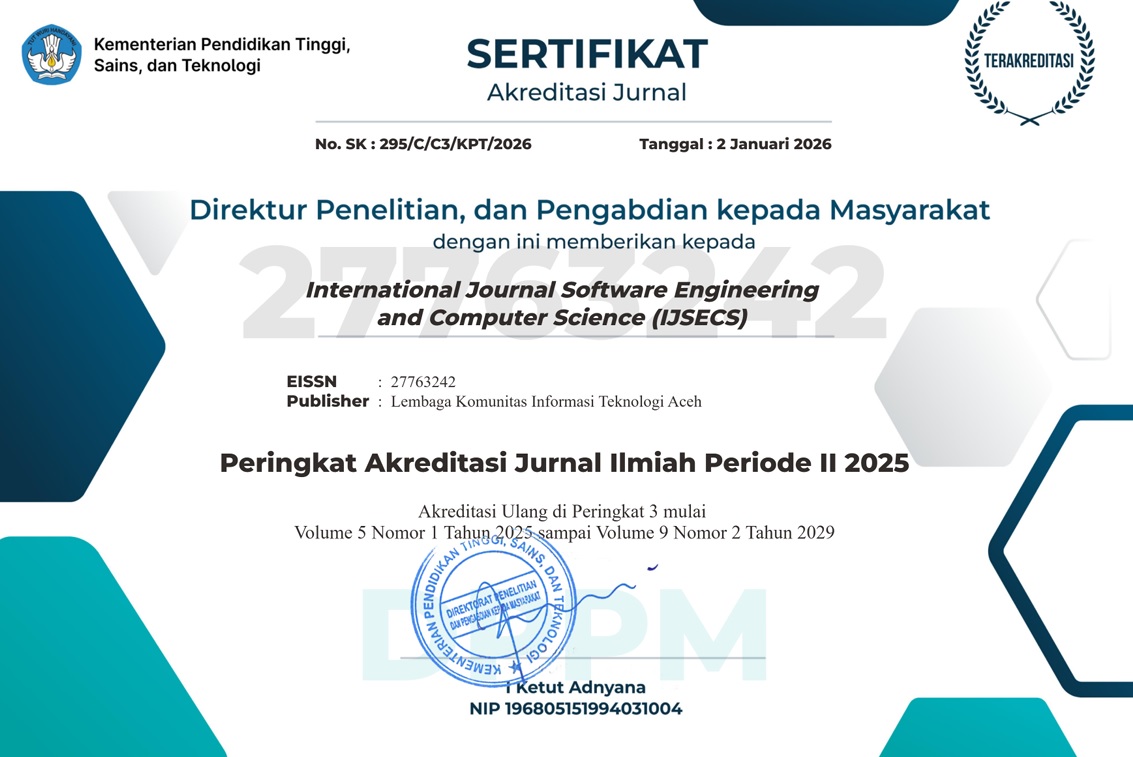
About the Journal

International Journal Software Engineering and Computer Science (IJSECS) is a free and open-access journal published by the Lembaga Komunitas Informasi Teknologi Aceh (KITA), Indonesia. IJSECS is a peer-reviewed, twice-annually published international journal that focuses on innovative, original, previously unpublished, experimental, or theoretical research concepts. IJSECS is committed to bridging the theory and practice of information technology and computer science. From innovative ideas to specific algorithms and full system implementations, IJSECS publishes original, peer-reviewed, and high-quality articles in the areas of information technology and computer science. IJSECS is a well-indexed scholarly journal and is indispensable reading and reference for people working at the cutting edge of information technology and computer science applications. All published article URLs will have a digital object identifier (DOI).

You can access the manuscript format from the author guidelines.

Download Manuscript Template:

Announcements

Current Issue

Vol. 6 No. 2 (2026): AUGUST 2026
Front Cover IJSECS VOLUME 6 NOMOR 2 AGUSTUS 2026

The August 2026 edition of IJSECS shows a clear shift toward applied, accountable, and locally grounded computing research. The issue moves across text mining, clinical classification, public-service evaluation, digital forensics, meteorological prediction, enterprise security, and web-based information systems without losing its practical orientation. Several studies place machine learning in domain-specific settings: Random Forest with SHAP is used to classify anemia severity from complete blood count data, RNN and LSTM models are applied to peak ground acceleration prediction, while MLP, LSTM, TCN, and CNN–LSTM are compared for rainfall and temperature forecasting. At the same time, the volume pays careful attention to usability and institutional services through evaluations of Access by KAI, Mobile JKN, SITARUNG, and the BMKG Pontianak maritime portal. Its engineering contributions are equally grounded, ranging from madrasah e-reporting, village complaint systems, MSME e-commerce, pharmacy stock management, laundry systems with WhatsApp gateway and chatbot support, to Google Apps Script-based sales analytics. Security and trust appear as major concerns through signature image forensics, biometric face verification, face authenticity detection for attendance, Golang concurrency testing, sensor failure detection, and the Living Citadel framework for adaptive enterprise hardening. The issue also connects computation with public behavior and policy, including digital bank reputation modeling, FIFA World Cup 2026 interest forecasting, MOORA-based research proposal prioritization, land suitability classification, AI adoption among MSMEs, and political sentiment analysis on Platform X. Taken together, this edition presents systems research that is not only technical, but also attentive to reliability, public value, and decision-making contexts.

Published: 2026-08-01

Articles

View All Issues