
About the Journal
Focus and Scope
The International Journal of Software Engineering and Computer Science (IJSECS) (E-ISSN: 2776-3242 | P-ISSN: 2776-4869) serves as a prominent platform for disseminating cutting-edge research in the fields of software engineering and computer science. IJSECS publishes high-quality, peer-reviewed articles that explore contemporary issues, methodologies, and advancements within these domains. The journal aims to advance the understanding and practice of software engineering, computer science, and related interdisciplinary fields by showcasing innovative research contributions from scholars, researchers, and practitioners worldwide.
The journal covers, but is not limited to, the following topics:
Peer Review Process
Submitted papers must be original, unpublished, and not under consideration for publication elsewhere at the time of submission. All manuscripts submitted to IJSECS undergo a rigorous double-blind peer review process conducted by at least two independent international reviewers with relevant expertise in the subject area.
- Initial Screening — The editorial team checks the manuscript for scope, formatting, and plagiarism compliance.
- Plagiarism Check — All submissions are screened using iThenticate and Turnitin prior to peer review.
- Double-Blind Review — Manuscripts are sent to at least two qualified reviewers; both author and reviewer identities remain anonymous.
- Editorial Decision — Based on reviewer recommendations: Accept, Minor Revision, Major Revision, or Reject.
- Revision & Re-review — Revised manuscripts may be returned to reviewers for re-evaluation.
- Final Decision & Production — Accepted manuscripts proceed to copyediting, layout, and publication.
IJSECS strives for a rigorous yet efficient review process. Our current average turnaround times are as follows: Time to First Decision ~2 weeks — Review Time ~4 weeks — Submission to Acceptance ~6 weeks — Acceptance to Publication ~2 weeks.
IJSECS is committed to a fair, transparent, and timely review process in accordance with the best practices recommended by COPE (Committee on Publication Ethics).
Special Issue Policy
IJSECS periodically publishes Special Issues dedicated to emerging and high-impact topics within software engineering and computer science. Special Issues are guest-edited by leading experts in the field and undergo the same rigorous double-blind peer review process as regular submissions.
Proposals for Special Issues are welcome and should include:
- A clear title and description of the proposed theme
- Relevance to the journal’s scope and current research trends
- Names and affiliations of proposed Guest Editors
- Proposed timeline for submission, review, and publication
Special Issue proposals may be submitted to the editorial office via the Contact Us page. Accepted proposals will be announced through the journal’s official channels, including the website and mailing list.
AI Policy
IJSECS acknowledges the growing role of Artificial Intelligence (AI) tools in academic writing and research. The following policy applies to all submissions:
- Disclosure required — Authors must clearly disclose in the manuscript (e.g., in the Methods or Acknowledgements section) if AI-assisted tools (e.g., ChatGPT, Copilot, Grammarly AI) were used in the preparation, writing, or editing of the manuscript.
- AI cannot be an author — AI tools do not meet the criteria for authorship and must not be listed as authors or co-authors.
- Author responsibility — Authors bear full responsibility for the accuracy, integrity, and originality of all content, including any AI-assisted portions.
- AI-generated content — Manuscripts that are substantially generated by AI without significant intellectual contribution from the authors will be rejected.
This policy is aligned with the guidelines of COPE and leading international publishers.
Publication Frequency
IJSECS is published triannually — three issues per year in the following months: April, August, and December. Each issue features a collection of peer-reviewed research articles, reviews, and technical communications covering the full scope of software engineering and computer science.
Open Access Statement
IJSECS is a fully Open Access journal. All published content is freely available online immediately upon publication, without subscription or pay-per-view fees. Users are allowed to read, download, copy, distribute, print, search, or link to the full texts of articles, consistent with the principles of open access.
This journal believes that making research freely available to the public supports a greater global exchange of knowledge and is associated with increased readership and citation impact. For more information, see the Public Knowledge Project.
Article Processing Charges (APC)
IJSECS applies an Article Processing Charge (APC) to cover the costs of peer review management, copyediting, typesetting, and online hosting. APC details, including applicable fees and waiver information, are available on the Publication Fee page.
IJSECS is committed to full transparency in publication fees as part of its open access principles. Waivers or discounts may be available for authors from low-income countries or in cases of demonstrated financial hardship. Please contact the editorial office for further information.
Digital Object Identifier (DOI)
All articles published in IJSECS are assigned a unique Digital Object Identifier (DOI) via Crossref, ensuring permanent and reliable linking to published content. DOIs are assigned upon final publication and are included in all article metadata.
Copyright and License
Authors who publish in IJSECS retain copyright of their work. All articles are published under the Creative Commons Attribution 4.0 International License (CC BY 4.0), which permits unrestricted use, distribution, and reproduction in any medium, provided the original work is properly cited. Copyright is held by the Author, and the copyright year follows the issue’s publication date.

Plagiarism & AI Detection Policy
IJSECS has a strict policy against plagiarism and academic misconduct. All submitted manuscripts are screened using iThenticate and Turnitin before entering the peer-review process. Manuscripts with a similarity index exceeding the acceptable threshold will be returned to the authors for revision or rejected outright.
Authors must also disclose any use of AI-assisted writing tools. Undisclosed AI-generated content is considered a form of academic misconduct and will be handled under COPE guidelines. Please refer to our AI Policy section above for full details.
Publication Ethics
IJSECS is committed to upholding the highest standards of publication ethics for all parties involved — authors, reviewers, and editors. Our publication ethics policy covers author duties, reviewer responsibilities, editorial standards, conflict of interest, retraction and correction procedures, and handling of misconduct. For the complete statement, please visit our dedicated Publication Ethics page.
Conflict of Interest Policy
All authors, reviewers, and editors are required to disclose any potential conflicts of interest that could influence the objectivity or integrity of the research or review process.
- Authors — must declare all competing interests in the submitted manuscript.
- Reviewers — must decline to review manuscripts in which they have a conflict of interest.
- Editors — must recuse themselves from handling manuscripts where a conflict exists.
Retraction and Correction Policy
IJSECS follows the COPE Retraction Guidelines for handling post-publication corrections, retractions, and expressions of concern.
- Correction — issued when a minor error does not affect the overall findings or conclusions.
- Retraction — issued when an article contains major errors, fabricated data, plagiarism, or serious ethical violations.
- Expression of Concern — issued when an investigation is ongoing and there is uncertainty about the integrity of the work.
Retracted articles remain visible on the journal website with a clear retraction notice and are flagged in all relevant databases and indexing services.
Archiving Policy
IJSECS is committed to the long-term preservation and accessibility of all published content. The journal participates in both LOCKSS and CLOCKSS archiving systems, enabling participating libraries worldwide to create permanent archives of the journal for purposes of preservation and restoration.
- LOCKSS — This journal is registered with the LOCKSS system. Participating libraries may use the LOCKSS system to collect, preserve, and restore this journal’s content.
- CLOCKSS — This journal is registered with the CLOCKSS system. Participating libraries may use the CLOCKSS system to collect, preserve, and restore this journal’s content.
Authors are also encouraged to self-archive their accepted manuscripts in institutional or subject repositories.
Journal History
- 2021 — IJSECS was first published in early 2021, establishing itself as a peer-reviewed platform for software engineering and computer science research.
- 2022 — In September 2022, IJSECS was officially accredited at SINTA 4 by the Ministry of Education, Culture, Research and Technology of Indonesia, applicable from Volume 1 Number 1 (2021) to Volume 5 Number 2 (2025).
- 2023 — IJSECS adopted a triannual publication schedule, releasing issues in April, August, and December of each year.
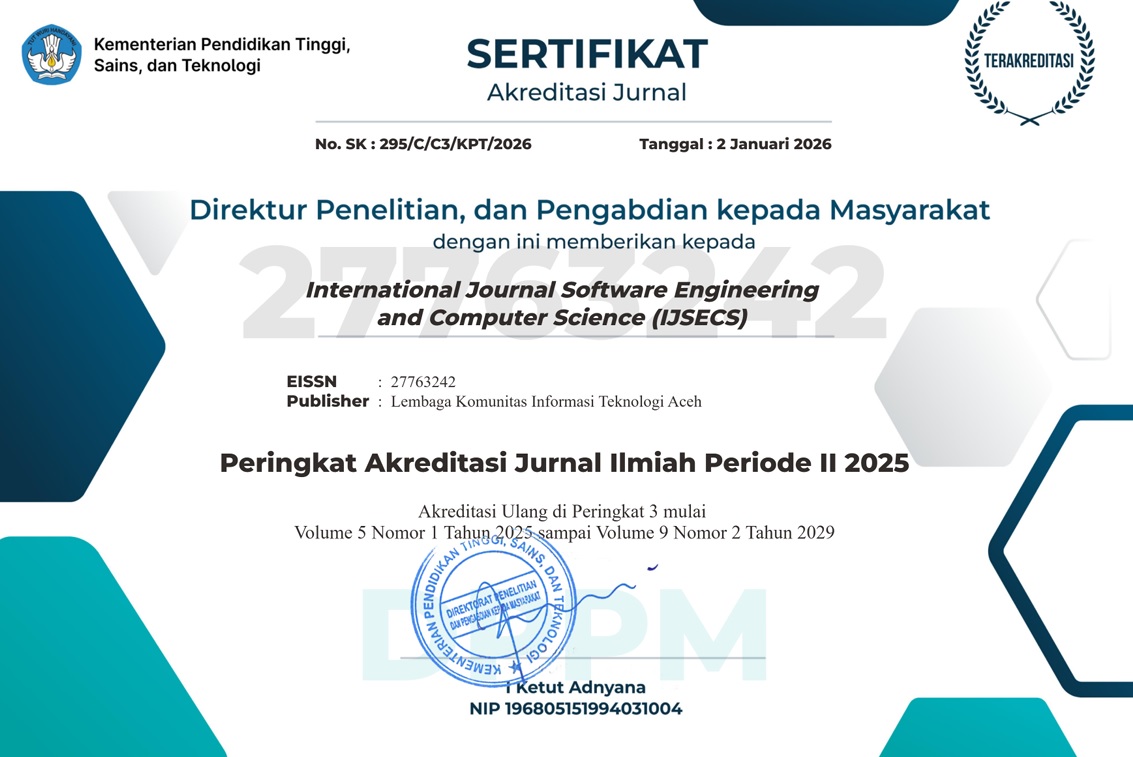
- 2025 — IJSECS was re-accredited at SINTA 3 by the Ministry of Education, Culture, Research and Technology of Indonesia, valid through 2029.
- 2026 — IJSECS migrated its official domain from .org to .com to better reflect its growing international presence and accessibility.


