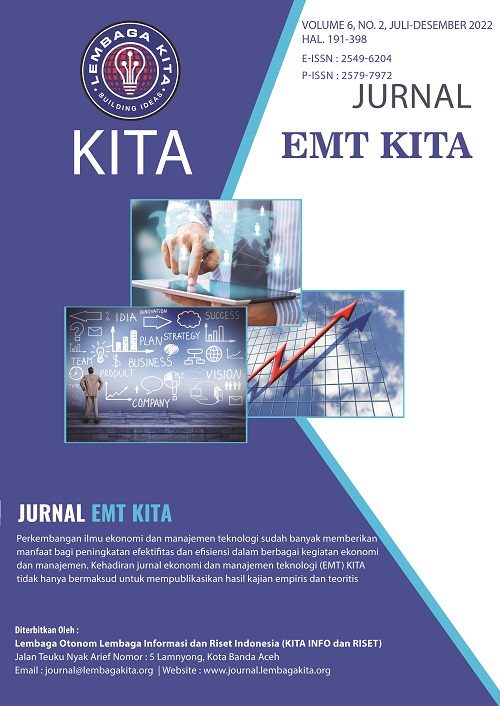
Prediksi Tingkat Pengangguran Berdasarkan Data Time Series Menggunakan Regresi Linear (Studi Kasus : Kota Salatiga)
DOI:
https://doi.org/10.35870/emt.v6i2.702Keywords:
Unemployment, Salatiga City, Linear RegressionAbstract
Unemployment is a very big problem. Coupled with the outbreak of the COVID-19 virus which resulted in many employees and workers being laid off. The purpose of this study is to predict the unemployment rate based on the number of the workforce. To produce an accurate prediction requires valid data in the long term. This makes it a reference for forecasting the unemployment population in a 5-year time series. For forecasting, a method is needed, namely the Linear Regression method. Linear regression is a statistical method that serves to test how far the relationship between the causal variables and the effect variables is. After forecasting, prediction data is generated in 2022, and the population and unemployment have changed from the previous year. Where the population in 2022 is predicted to be 144189 and the number of unemployed is 4513 people. This result is a prediction, not 100% accurate, therefore it would be better if you use another method to compare the prediction results and the level of accuracy.
Downloads
References
Al’afi, A. M., Widiarti, W., Kurniasari, D., & Usman, M. (2020). Peramalan Data Time Series Seasonal Menggunakan Metode Analisis Spektral. Jurnal Siger Matematika, 1(1), 10-15.
Ashari, M. L., & Sadikin, M. (2020). Prediksi Data Transaksi Penjualan Time Series Menggunakan Regresi Lstm. Jurnal Nasional Pendidikan Teknik Informatika: JANAPATI, 9(1), 1-10.
C. Nurine S. K (2018). “Analisis Pengaruh Indeks Pembangunan Manusia, Tingkat Pengangguran, Pertumbuhan Ekonomi, dan Upah Minimum Provinsi Terhadap Tingkat Kemiskinan (Studi Kasus pada 6 Provinsi di Pulau Jawa)”, Fakultas Ekonomi dan Bisnis. Universitas Brawijaya.
F. S. Nur Ravika. (2016). “Pengaruh Variabel Ekonomi Makro Terhadap Pengangguran Terdidik Jawa Timur Tahun 2010-2014. Surabaya : PT.Bumi Universal Makmur”, Jurnal Ekonomi Pembangunan Vol.14, No.01 Juni 2016.
Fadlillah, Nurul. (2016). “Analisis Pengaruh Pendapatan Per Kapita, Tingkat Pengangguran, IPM dan Pertumbuhan Penduduk Terhadap Kemiskinan di Jawa Tengah Tahun 2009-2013”, Fakultas Ekonomi dan Bisnis, Universitas Jenderal Soedirman. EKO-REGIONAL, VOL.11, No.1.
I. H. Andrian. “Penerapan Metode Fuzzy Time Series Untuk Prediksi Penjualan Berbasis WEB pada CV.AGVA Kota Pasuruan”. Teknik Informatika, ITN Malang, Malang.
Ikhlas, M., & Adipradana, W. (2020). Peramalan Beban Pada Tahun 2019-2023 Menggunakan Metode Time Series Pada Penyulang Dieng Di Gardu Induk Simpang Tiga Indralaya (Doctoral dissertation, Sriwijaya University).
Katemba, P., & Djoh, R. K. (2017). Prediksi Tingkat Produksi Kopi Menggunakan Regresi Linear. Jurnal ilmiah FLASH, 3(1), 42-51.
N. Shofiatin. (2018). “Pengaruh Jumlah Penduduk dan Jumlah Pengangguran Terhadap Jumlah Penduduk Miskin di Provinsi Banten”, Fakultas Ekonomi dan Bisnis Islam. Universitas Islam Negeri Sultasn Maulana Hasanuddin Banten.
Nidyashofa, Nurika. (2020). “Pemilihan Model Regresi Spasial Terbaik Pada Tingkat Pengangguran Terbuka Di Provinsi Jawa Tengah”. Program Studi S1 Statistika. Fakultas Matematika Dan Ilmu Pengetahuan Alam. Universitas Muhammadiyah Semarang. Semarang.
Oktavianti, I., Ermatita, E., & Rini, D. P. (2019). Analisis Pola Prediksi Data Time Series menggunakan Support Vector Regression, Multilayer Perceptron, dan Regresi Linear Sederhana. Jurnal RESTI (Rekayasa Sistem dan Teknologi Informasi), 3(2), 282-287.
P. Ratih. (2016). “Pengangguran dan Pengaruhnya terhadap Tingkat Kemiskinan. Balai Besar Penelitian dan Pengembangan Pelayanan Kesejahteraan Sosial”, Jurnal PKS Vol 15 No 2 Juni 2016; 89-100.
R. A. Salbiah and W. Adi. (2016). “Faktor-faktor yang mempengarhui tingkat kemiskinan”, Fakultas Ekonomi dan Bisnis, Universitas Mulawarman, Samarinda. JIEM – Volume 1(1), 2016.
Rahakbauw, dkk. (2018). “Sistem Prediksi Tingkat Pengangguran Di Provinsi Maluku Menggunakan ANFIS (Adaptive Neuro Fuzzy Inference System)”. Jurusan Matematika FMIPA. Universitas Pattimura. Ambon.
S. Dwi (2018). “Penyebab Tingginya Angka Pengangguran Di Kota Metro”, Fakultas Ekonomi Dan Bisnis Islam. Institut Agama Islam Negeri Metro.
Sandy, dkk. (2019). “Analisa Pengaruh Pendapatan Asli Daerah dan Dana Desa Dalam Menurunkan Tingkat Kemiskinan Di 11 Kabupaten Provinsi Sulawesi Utara”. Jurusan Ekonomi Pembangunan, Fakultas Ekonomi dan Bisnis. Universitas Sam Ratulangi. Manado.
Sumardin, A., & Mashud, M. (2018). Penerapan Metode Time Series Dalam Memprediksi Hasil Produksi Pertanian Berdasarkan Nilai Trend. Inspiration: Jurnal Teknologi Informasi dan Komunikasi, 8(1), 25-30.
Wahyuni, S. C. (2021). Peramalan Jumlah Penduduk Miskin Di Pulau Jawa Menggunakan Metode Fuzzy Time Series Chen (Doctoral dissertation, UNIVERSITAS MUHAMMADIYAH JEMBER).
Yunus, Erna. (2022). “Angka Kemiskinan Salatiga 2021 Naik 5,14%”. Angka Kemiskinan Salatiga 2021 Naik 5,14% - RMOL JATENG (rmoljawatengah.id). Diakses pada 30 April 2022.
Downloads
Published
Issue
Section
License
Copyright (c) 2022 Dio Yudha Perdana, Magdalena A. Ineke Pakereng

This work is licensed under a Creative Commons Attribution-NonCommercial-NoDerivatives 4.0 International License.
Authors who publish with this journal agree to the following terms:
1. Copyright Retention and Open Access License
Authors retain copyright of their work and grant the journal non-exclusive right of first publication under the Creative Commons Attribution 4.0 International License (CC BY 4.0).
This license allows unrestricted use, distribution, and reproduction in any medium, provided the original work is properly cited.
2. Rights Granted Under CC BY 4.0
Under this license, readers are free to:
- Share — copy and redistribute the material in any medium or format
- Adapt — remix, transform, and build upon the material for any purpose, including commercial use
- No additional restrictions — the licensor cannot revoke these freedoms as long as license terms are followed
3. Attribution Requirements
All uses must include:
- Proper citation of the original work
- Link to the Creative Commons license
- Indication if changes were made to the original work
- No suggestion that the licensor endorses the user or their use
4. Additional Distribution Rights
Authors may:
- Deposit the published version in institutional repositories
- Share through academic social networks
- Include in books, monographs, or other publications
- Post on personal or institutional websites
Requirement: All additional distributions must maintain the CC BY 4.0 license and proper attribution.
5. Self-Archiving and Pre-Print Sharing
Authors are encouraged to:
- Share pre-prints and post-prints online
- Deposit in subject-specific repositories (e.g., arXiv, bioRxiv)
- Engage in scholarly communication throughout the publication process
6. Open Access Commitment
This journal provides immediate open access to all content, supporting the global exchange of knowledge without financial, legal, or technical barriers.