About the Journal

  • International Journal Education and Computer Studies (IJECS) is a free and open-access journal published by the Lembaga Komunitas Informasi Teknologi Aceh (KITA), Indonesia. International Journal Education and Computer Studies (IJECS) publishes triannual, showcasing innovative and original research in both theoretical and experimental realms within modern education and computer science. It serves as a vital link between theoretical insights and practical applications in these fields. IJECS accepts contributions ranging from novel concepts to detailed algorithmic discussions and complete system implementations. With a commitment to excellence, each article undergoes rigorous peer review to ensure high quality. Indexed in leading databases, IJECS is essential reading for professionals and researchers at the forefront of computer science and modern education. Additionally, all published articles are assigned digital object identifiers (DOIs), providing a reliable means of citation and reference.

    You can access the manuscript format from the author guidelines.

    Download Manuscript Template:

Announcements

Current Issue

Vol. 6 No. 2 (2026): JULY
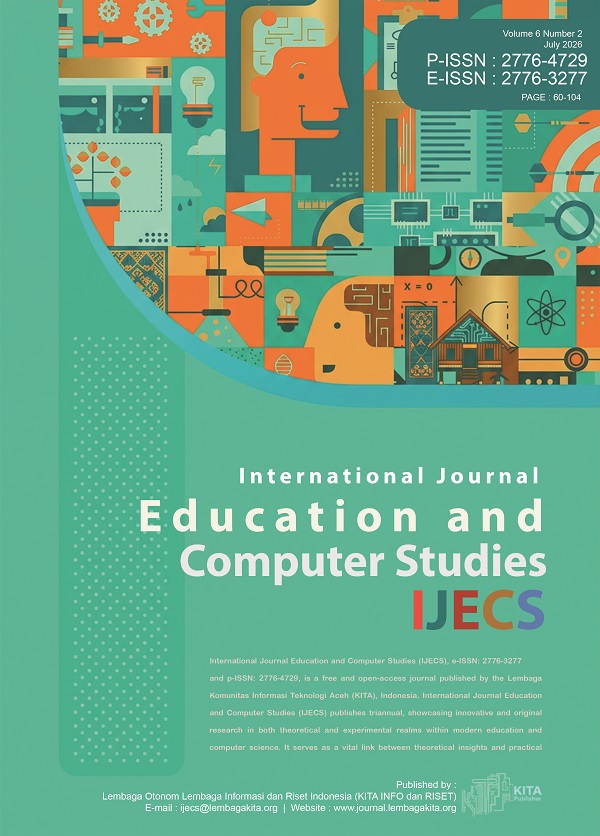
Cover IJECS VOLUME 6 NOMOR 2 2026 July

The July issue (Vol. 6 No. 2, 2026) interrogates how Indonesian education is adapting to the demands of a more connected, more accountable, and more pedagogically conscious era. Two studies converge on the economics classroom at State Senior High School 11 Jambi City from different directions — the first tests whether project-based learning can move the needle on actual learning outcomes, while the second asks whether digital literacy and educational social media can sustain student motivation in a subject many learners find abstract and distant from daily life — together suggesting that neither method nor medium alone is sufficient. A usability evaluation of a Google Sites-based e-learning platform, measured against the ISO 9241-11:2018 standard, brings a welcome dose of rigor to a space where tools are often adopted on convenience rather than evidence. A chatbot-integrated website profile developed for a Madrasah Tsanawiyah addresses a quieter but persistent problem — the gap between the information an institution holds and what prospective students and parents can actually reach — testing whether automation can close that gap without sacrificing interaction quality. The issue closes with a case study of POAC-based educational management at SMA Negeri 1 Sabang, tracing what happens when a school commits to applying a structured management framework across its operations; as a single-site study its generalizability is limited by design, but the granularity of the documentation makes it a useful reference point for practitioners navigating similar institutional challenges. Across all contributions, the issue returns to a question Indonesian education continues to wrestle with: whether the systems, tools, and methods being adopted are genuinely improving what happens for students — or simply replacing one set of assumptions with another.

Published: 2025-07-30
View All Issues