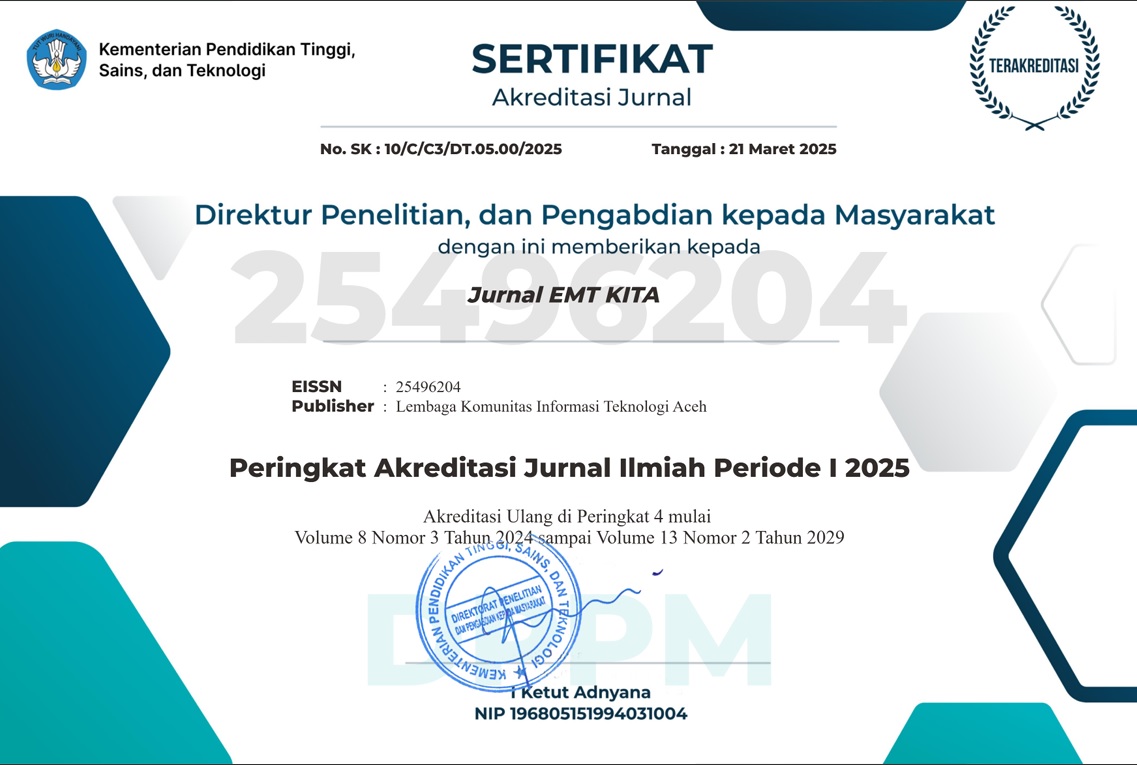
The Impact of Job Satisfaction, Welfare, and Visionary Leadership on Employee Organizational Commitment at Teuku Umar Aceh Jaya Regional General Hospital
DOI:
https://doi.org/10.35870/emt.v9i1.3415Keywords:
Job Satisfaction, Welfare, Visionary Leadership, Organizational Commitment, Hospital, Health ServicesAbstract
This study aims to analyze the impact of job satisfaction, welfare, and visionary leadership on employee organizational commitment at the Teuku Umar Aceh Jaya Regional General Hospital (RSUD). Organizational commitment is a key factor in improving individual and institutional performance, especially in the health service sector. Employee job satisfaction and well-being play an important role in creating a supportive work environment, while visionary leadership can provide strategic direction that motivates employees to achieve organizational goals. This study uses a quantitative approach with a survey method. Data was collected through a questionnaire distributed to 100 employees of Teuku Umar Hospital, which was selected using a stratification sampling technique. Data analysis was carried out using multiple regression to test the influence of each independent variable on the dependent variable. The results of the study show that job satisfaction, welfare, and visionary leadership have a significant effect simultaneously or partially on employee organizational commitment. Visionary leadership has the greatest influence, followed by job satisfaction and well-being. These findings underscore the importance of leadership that inspires a shared vision and the need to improve job satisfaction and well-being to strengthen employee commitment to the organization. The recommendations of this research include the development of visionary leadership training programs, improvement of work facilities, and the preparation of welfare policies oriented to employee needs. This research contributes to understanding the factors that affect organizational commitment in the health service sector and can be a reference for policymakers in an effort to improve the quality of hospital services.
Downloads
References
Ali, M. M. (2022). Metodologi Penelitian Kuantitatif Dan Penerapan Nya Dalam Penelitian. JPIB: Jurnal Penelitian Ibnu Rusyd, 1(2), 1-5.
Amaliya, M., Magfiroh, N., & Ghifari, M. S. (2024). Sistem Remunerasi dalam Meningkatkan Kinerja Pendidik di SMPN 39 Surabaya. Jurnal Pendidikan Transformatif, 3(2), 1-15. DOI: https://doi.org/10.9000/jpt.v3i2.1620.
Bass, B. M. (1985). Leadership: good, beter, best, organizational dynamics. NY: Academy of Leadership..
Bass, B. M., & Avolio, B. J. (1994). Transformational leadership and organizational culture. The International journal of public administration, 17(3-4), 541-554.
Damanik, M. (2020). Artikel Pengaruh Kepemimpinan, Motivasi, Dan Remunerasi Terhadap Budaya Kerja Dan Peningkatan Kinerja Pegawai Di Lingkungandirektorat Jenderal Pajak Kpp Pratama Pematang Siantar. Jurnal Manajemen Pendidikan dan Ilmu Sosial, 2(1), 194-212. DOI: https://doi.org/10.38035/jmpis.v2i1.441.
Diener, E. (2000). Subjective well-being: The science of happiness and a proposal for a national index. American psychologist, 55(1), 34.
Ghozali, I. (2016). Aplikasi analisis multivariete dengan program IBM SPSS 23.
Jamaluddin, J., Istofa, D. N., & Suremi, B. (2021). Pengaruh Kepemimpinan Kepala Sekolah terhadap Motivasi Kerja Guru di MA Swasta Nururrodhiyah Kota Jambi. JMiE (Journal of Management in Education), 6(2), 91-100. DOI: https://doi.org/10.30631/jmie.2021.62.91-100.
Latief, A., Syardiansah, S., & Safwan, M. (2019). Pengaruh Komitmen Organisasi dan Kepuasan Kerja terhadap Kinerja Karyawan BPJS Kesehatan Cabang Langsa. J-EBIS (Jurnal Ekonomi dan Bisnis Islam), 52-65. DOI: https://doi.org/10.32505/v4i1.1250.
Locke, E. A., Sirota, D., & Wolfson, A. D. (1981). An Experimental Case Study of the Successes and Failures of Job Enrichment in a Government Agency. In Psychology and Industrial Productivity: A Reader (pp. 39-62). London: Palgrave Macmillan UK.
Lyubomirsky, S., King, L., & Diener, E. (2005). The benefits of frequent positive affect: Does happiness lead to success?. Psychological bulletin, 131(6), 803.
Ma’ruf, R. (2021). Pengaruh Kompensasi dan Work Life Balance Terhadap Loyalitas Karyawan. Psikoborneo: Jurnal Ilmiah Psikologi, 9(1), 110-120.
Meyer, J. P., & Allen, N. J. (1991). A three-component conceptualization of organizational commitment. Human resource management review, 1(1), 61-89. DOI: https://doi.org/10.1016/1053-4822(91)90011-Z.
Podsakoff, P. M., MacKenzie, S. B., & Bommer, W. H. (1996). Transformational leader behaviors and substitutes for leadership as determinants of employee satisfaction, commitment, trust, and organizational citize. Journal of management, 22(2), 259-298.
Pratiwi, R., & Apriandi, A. (2019). Pengaruh Kompensasi dan Lingkungan Kerja Terhadap Kepuasan Kerja Karyawan PT. Tor Ganda Medan.
Retnawati, H. (2017, September). Teknik pengambilan sampel. In Disampaikan pada workshop update penelitian kuantitatif, teknik sampling, analisis data, dan isu plagiarisme (pp. 1-7).
Salahudin, D. N., Lengkong, V. P., & Tulung, J. E. (2018). PENGARUH KOMUNIKASI DAN GAYA KEPEMIMPINAN SERTA BUDAYA ORGANISASI TERHADAP KOMITMEN ORGANISASI DAN DAMPAKNYA PADA KEPUASAN KERJA PEGAWAI NEGERI SIPIL PADA KANTOR KECAMATAN SE KOTA KOTAMOBAGU. Jurnal EMBA: Jurnal Riset Ekonomi, Manajemen, Bisnis dan Akuntansi, 6(3). DOI: https://doi.org/10.35794/emba.v6i3.20703.
Sobaih, A. E. E., & Hasanein, A. M. (2020). Herzberg’s theory of motivation and job satisfaction: Does it work for hotel industry in developing countries?. Journal of Human Resources in Hospitality & Tourism, 19(3), 319-343.
Sriwidodo, U., & Haryanto, A. B. (2010). Pengaruh kompetensi, motivasi, komunikasi dan kesejahteraan Terhadap kinerja pegawai dinas pendidikan. Jurnal Manajemen Sumber Daya Manusia, 4(1), 47-57.
Sugiyono, S. (2016). Metode penelitian kuantitatif, kualitatif, R&D. Bandung: Alfabeta, 1-11.
Wirawan, D. (2013). Kepemimpinan: Teori, psikologi, perilaku organisasi, Aplikasi dan Penelitian. Jakarta PT. Rajagrafindo Persada.
Downloads
Published
Issue
Section
License
Authors who publish with this journal agree to the following terms:
1. Copyright Retention and Open Access License
Authors retain copyright of their work and grant the journal non-exclusive right of first publication under the Creative Commons Attribution 4.0 International License (CC BY 4.0).
This license allows unrestricted use, distribution, and reproduction in any medium, provided the original work is properly cited.
2. Rights Granted Under CC BY 4.0
Under this license, readers are free to:
- Share — copy and redistribute the material in any medium or format
- Adapt — remix, transform, and build upon the material for any purpose, including commercial use
- No additional restrictions — the licensor cannot revoke these freedoms as long as license terms are followed
3. Attribution Requirements
All uses must include:
- Proper citation of the original work
- Link to the Creative Commons license
- Indication if changes were made to the original work
- No suggestion that the licensor endorses the user or their use
4. Additional Distribution Rights
Authors may:
- Deposit the published version in institutional repositories
- Share through academic social networks
- Include in books, monographs, or other publications
- Post on personal or institutional websites
Requirement: All additional distributions must maintain the CC BY 4.0 license and proper attribution.
5. Self-Archiving and Pre-Print Sharing
Authors are encouraged to:
- Share pre-prints and post-prints online
- Deposit in subject-specific repositories (e.g., arXiv, bioRxiv)
- Engage in scholarly communication throughout the publication process
6. Open Access Commitment
This journal provides immediate open access to all content, supporting the global exchange of knowledge without financial, legal, or technical barriers.