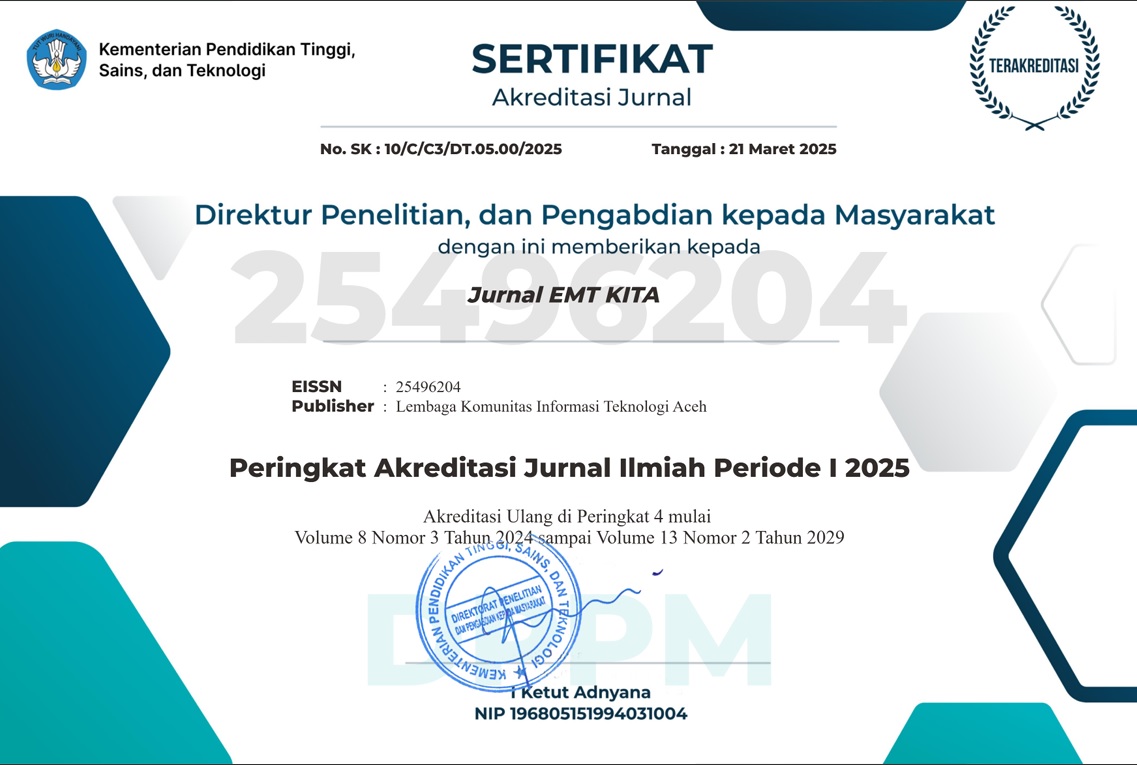
Determinan Pekerjaan Layak: Analisis dan Dampak Studi Kasus di Sumatera Barat
DOI:
https://doi.org/10.35870/emt.v9i3.4338Keywords:
Decent Work, Job Opportunities, Education, Marital Status, Age, Gender, Job TrainingAbstract
This study aims to describe the determinants of the characteristics of the workforce in West Sumatera and analyze the impact of job opportunities, education, marital status, age, gender, and job training on Decent Work in West Sumatera. The problems faced by the labor force are the unfulfilled decent wages for each worker in both the formal and informal sectors which disrupts the productivity of workers. In addition, the existence of child labor and free workers who are not guaranteed job protection from the workplace has an impact on the economy of individuals and households. This study uses a quantitative method with SAKERNAS 2021 data include the sample total is 28.251 sample. Metode analysis using logistic regression and data tabulation to calculate the characteristic and impact of decent work in West Sumatera. The results show that the characteristics of workers from the education sector are dominated by elementary, junior high, high school / vocational high school graduates compared to graduates from university. The impact of job opportunities, education, marital status, age, gender, and job training has a positive and significant effect on decent work in West Sumatera. The government as policy maker, needs to develop and planning that ensure the safety and well-being of workers, with the goal of creating decent and productive work.
Downloads
References
Ahmed, I. (2003). Decent work and human development. Int'l Lab. Rev., 142, 263.
Alao, O. E., Afuape, I. H., Taiwo, A., & Muraina, Q. O. (2021). Empowering business education students for decent work and productive employment: Nigeria example.
Anker, R., Chernyshev, I., Egger, P., & Mehran, F. (2003). Measuring decent work with statistical indicators. Int'l Lab. Rev., 142, 147.
Basil, O. C., Nwokoye, E., & Aduku, E. B. (2021). Computing education, decent work and economic growth in Nigeria. International Journal of Economics Development Research (IJEDR), 2(1), 44-64.
Becker, G. S. (1964). Human capital: a theoretical and empirical analysis, with special reference to education (Vol. 3). Chicago: University of Chicago Press.
Cohen, T., & Moodley, L. (2012). Achieving" decent work" in South Africa?. Potchefstroom Electronic Law Journal, 15(2), 319-344.
Dwi Atmanti, H. (2005). Investasi sumber daya manusia melalui pendidikan. Jurnal Dinamika Pembangunan (JDP), 2(Nomor 1), 30-39.
Ferraro, T., Pais, L., & Santos, N. R. D. (2015). Decent work: An aim for all made by all.
Ferreira, J. A., Haase, R. F., Santos, E. R., Rabaça, J. A., Figueiredo, L., Hemami, H. G., & Almeida, L. M. (2019). Decent work in Portugal: Context, conceptualization, and assessment. Journal of Vocational Behavior, 112, 77-91.
Ghai, D. P. (2002). Decent work: Concepts, models and indicators (Vol. 139). International Institute for Labour Studies.
Hosmer, D. W., Lemeshow, S., & Sturdivant, R. X. (2000). Applied logistic regression. Hoboken.
Hussain, A. B., & Endut, N. (2018). Do decent working conditions contribute to work–life balance: A study of small enterprises in Bangladesh. Asia Pacific Journal of Innovation and Entrepreneurship, 12(1), 90-104.
Mankiw, N. G. (2006). Pengantar teori ekonomi makro (Edisi ketiga). Jakarta: Salemba Empat.
Masdonati, J., Schreiber, M., Marcionetti, J., & Rossier, J. (2019). Decent work in Switzerland: Context, conceptualization, and assessment. Journal of Vocational Behavior, 110, 12-27.
Okuwa, O. B. (2020). Job creation and decent work in Oyo State Nigeria. Modern Economy, 11(11), 1752.
Pentury, T., Aulele, S. N., & Wattimena, R. (2016). Analisis Regresi Logistik Ordinal. BAREKENG: Jurnal Ilmu Matematika Dan Terapan, 10(1), 55-60.
Pereira, S., dos Santos, N. R., & Pais, L. (2019). Empirical research on decent work: a literature review.
Riaz, S., Xu, Y., & Hussain, S. (2018). Understanding employee innovative behavior and thriving at work: A Chinese perspective. Administrative Sciences, 8(3), 46. https://doi.org/10.3390/admsci8030046.
Ribeiro, M. A., Silva, F. F., & Figueiredo, P. M. (2016). Discussing the notion of decent work: Senses of working for a group of Brazilian workers without college education. Frontiers in Psychology, 7, 207.
Setyanti, A. M. (2020). Informality and the education factor in Indonesian labor. Journal of Indonesian Applied Economics, 8(2), 71-80.
Seubert, C., Hopfgartner, L., & Glaser, J. (2021). Living wages, decent work, and need satisfaction: An integrated perspective. European Journal of Work and Organizational Psychology, 30(6), 808-823.
Statistik, B. P. (2022). Keadaan Angkatan Kerja Di Sumatera Barat 2021. Padang: Badan Pusat Statistik.
Statistik, B. P. (2022). Rata-rata konsumsi perkapita seminggu di daerah perkotaan menurut komoditi makanan dan golongan pengeluaran per kapita seminggu (satuan komoditas), 2020-2021. Badan Pusat Statistik Indonesia, Jakarta.
Trung, T., Tien-Trung, N., Thao, T. T. P., & Hien, L. T. T. (2019). Does education improve employee benefits in Vietnam? The first evidence from matched employer–employee data. Cogent Education, 6(1), 1662162.
Wahyuni, S., Bachtiar, N., Elfindri, & Ridwan, E. (2019). A mapping of job opportunities for Indonesian migrant workers in the Malaysian manufacturing industry. The Journal of Social Sciences Research, 5(11), 1539-1550.
Work, I. D., PEACE, J., & WATER, C. (2015). the 2030 Agenda for sustainable development. ILO: Geneva, Switzerland.
Downloads
Published
Issue
Section
License
Copyright (c) 2025 Ibnu Hadi Asshidiqi, Fajri Muharja

This work is licensed under a Creative Commons Attribution 4.0 International License.
Authors who publish with this journal agree to the following terms:
1. Copyright Retention and Open Access License
Authors retain copyright of their work and grant the journal non-exclusive right of first publication under the Creative Commons Attribution 4.0 International License (CC BY 4.0).
This license allows unrestricted use, distribution, and reproduction in any medium, provided the original work is properly cited.
2. Rights Granted Under CC BY 4.0
Under this license, readers are free to:
- Share — copy and redistribute the material in any medium or format
- Adapt — remix, transform, and build upon the material for any purpose, including commercial use
- No additional restrictions — the licensor cannot revoke these freedoms as long as license terms are followed
3. Attribution Requirements
All uses must include:
- Proper citation of the original work
- Link to the Creative Commons license
- Indication if changes were made to the original work
- No suggestion that the licensor endorses the user or their use
4. Additional Distribution Rights
Authors may:
- Deposit the published version in institutional repositories
- Share through academic social networks
- Include in books, monographs, or other publications
- Post on personal or institutional websites
Requirement: All additional distributions must maintain the CC BY 4.0 license and proper attribution.
5. Self-Archiving and Pre-Print Sharing
Authors are encouraged to:
- Share pre-prints and post-prints online
- Deposit in subject-specific repositories (e.g., arXiv, bioRxiv)
- Engage in scholarly communication throughout the publication process
6. Open Access Commitment
This journal provides immediate open access to all content, supporting the global exchange of knowledge without financial, legal, or technical barriers.