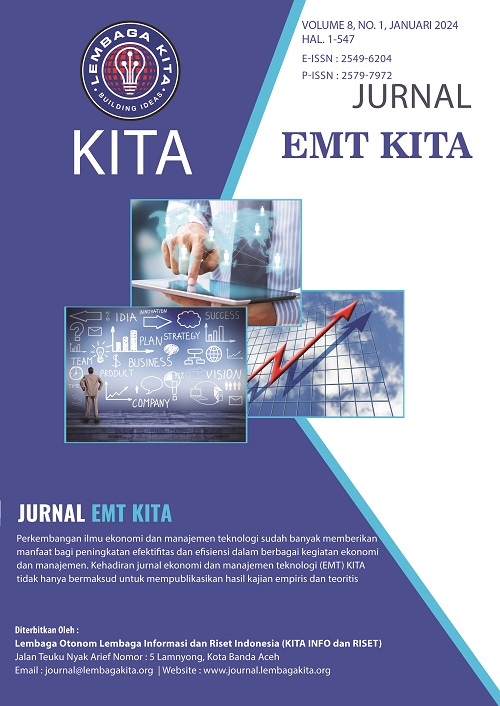
Dampak Reputasi, Responsifitas, Pemberian Hadiah, dan Rekomendasi terhadap Nasabah yang Berpindah dari BSI ke Bank Konvensional
DOI:
https://doi.org/10.35870/emt.v8i1.1707Keywords:
Brand Switching, Reputation, Responsive, Gift-Giving, RecommendationAbstract
This research aims to investigate the impact of reputation, responsiveness, gift-giving, and recommendations on Brand Switching, especially the movement of customers from Conventional Banks to Bank Syariah Indonesia (BSI). The research method uses multiple linear regression with a Likert Scale to collect data from 100 respondents who are customers from various cities in Indonesia, including Yogyakarta, Gorontalo, and Surakarta. The validity test results show that all variables have a valid correlation with Brand Switching. Multiple linear regression revealed that gifts had the greatest impact, while recommendations had a lower impact. The F test and t-test confirm that reputation, responsiveness, gift-giving, and recommendations simultaneously and partially significantly influence Brand Switching. Even though the Multiple R shows a relationship of 61.7%, the Adjusted R Square of 35.5% indicates that the model does not fully explain variations in Brand Switching. The conclusions of this research provide insight for bank management to improve reputation, responsiveness, and gift-giving strategies to reduce the level of Brand Switching. Future research is recommended to consider additional variables and a qualitative approach to explore the factors that influence customer decisions.
Downloads
References
Alwi, S. F. S., Ali, S. M., & Nguyen, B. (2017). The importance of ethics in branding: Mediating effects of ethical branding on company reputation and brand loyalty. Business Ethics Quarterly, 27(3), 393-422.
Aramburu, I. A., & Pescador, I. G. (2019). The effects of corporate social responsibility on customer loyalty: The mediating effect of reputation in cooperative banks versus commercial banks in the Basque country. Journal of business ethics, 154, 701-719.
Augusto de Matos, C., Luiz Henrique, J., & de Rosa, F. (2013). Customer reactions to service failure and recovery in the banking industry: the influence of switching costs. Journal of Services Marketing, 27(7), 526-538.
Buttle, F., & Burton, J. (2002). Does service failure influence customer loyalty?. Journal of Consumer Behaviour: an international research review, 1(3), 217-227.
Clark, N. (2019). Building a culturally responsive independent consulting practice. New Directions for Evaluation, 2019(164), 81-88.
Clemes, M. D., Gan, C., & Zhang, D. (2010). Customer switching behaviour in the Chinese retail banking industry. International Journal of Bank Marketing, 28(7), 519-546.
Clemes, M. D., Gan, C., & Zheng, L. Y. (2007). Customer switching behaviour in the New Zealand banking industry. Banks & bank systems, (2, Iss. 4), 50-65.
Debenedetti, A., Oppewal, H., & Arsel, Z. (2014). Place attachment in commercial settings: A gift economy perspective. Journal of Consumer Research, 40(5), 904-923.
Fahmi, I., & Rizal, S. (2021). The Effect of Reputation, Responsiveness, Giving Gifts and Recommendations on Customers Moving to Branch BNI Syariah Meulaboh Branch. Indonesian Journal Economic Review (IJER), 1(1), 26-34.
Gruen, T. W., Osmonbekov, T., & Czaplewski, A. J. (2006). eWOM: The impact of customer-to-customer online know-how exchange on customer value and loyalty. Journal of Business research, 59(4), 449-456.
Hajriyanti, R., & Akbar, R. (2021). Analisis Dampak Pandemi COVID 19 Terhadap Pemasaran Online di Kecil dan Usaha Menengah (UMKM). Jurnal Ekonomi dan Manajemen Teknologi Vol, 5(2).
Hall, R. (1993). A framework linking intangible resources and capabiliites to sustainable competitive advantage. Strategic management journal, 14(8), 607-618.
Downloads
Published
Issue
Section
License
Copyright (c) 2024 Salamatun Asakdiyah, Rachmiani, Musafir, Hasim

This work is licensed under a Creative Commons Attribution-NonCommercial-NoDerivatives 4.0 International License.
Authors who publish with this journal agree to the following terms:
1. Copyright Retention and Open Access License
Authors retain copyright of their work and grant the journal non-exclusive right of first publication under the Creative Commons Attribution 4.0 International License (CC BY 4.0).
This license allows unrestricted use, distribution, and reproduction in any medium, provided the original work is properly cited.
2. Rights Granted Under CC BY 4.0
Under this license, readers are free to:
- Share — copy and redistribute the material in any medium or format
- Adapt — remix, transform, and build upon the material for any purpose, including commercial use
- No additional restrictions — the licensor cannot revoke these freedoms as long as license terms are followed
3. Attribution Requirements
All uses must include:
- Proper citation of the original work
- Link to the Creative Commons license
- Indication if changes were made to the original work
- No suggestion that the licensor endorses the user or their use
4. Additional Distribution Rights
Authors may:
- Deposit the published version in institutional repositories
- Share through academic social networks
- Include in books, monographs, or other publications
- Post on personal or institutional websites
Requirement: All additional distributions must maintain the CC BY 4.0 license and proper attribution.
5. Self-Archiving and Pre-Print Sharing
Authors are encouraged to:
- Share pre-prints and post-prints online
- Deposit in subject-specific repositories (e.g., arXiv, bioRxiv)
- Engage in scholarly communication throughout the publication process
6. Open Access Commitment
This journal provides immediate open access to all content, supporting the global exchange of knowledge without financial, legal, or technical barriers.