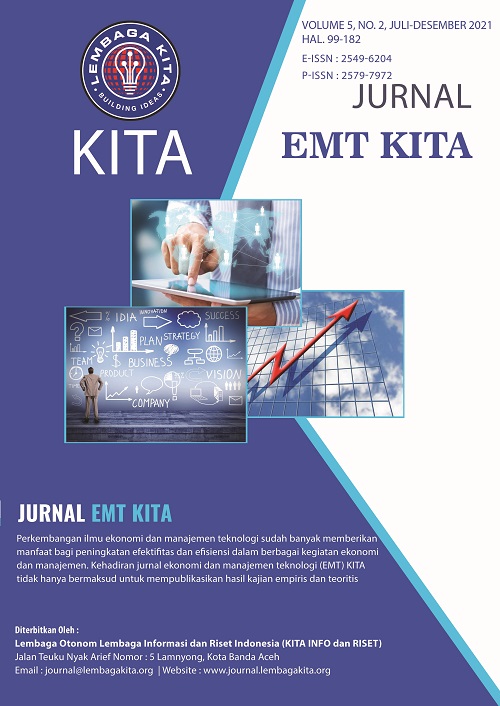
Analisis Tingkat Literasi Nasabah Bank Syariah Pada Kontrak Murabahah
DOI:
https://doi.org/10.35870/emt.v5i2.449Keywords:
Murabahah Contract, Murabahah Financing, Customer Understanding LevelAbstract
The purpose of this research is to examine the level of understanding of Islamic bank customers who have entered into murabahah contracts, as well as the factors that influence customer decisions to use Islamic banks for murabahah financing. 45 Islamic bank customers who have taken murabaha financing were selected as samples. The data used is primary data collected from customers who have taken murabaha credit through surveys and direct interviews. Qualitative analytical approach was used in data analysis. The findings show that customers are not aware of the murabahah financing arrangements.Downloads
References
Antonio, M. S. I. (2001). Bank Syariah: dari teori ke praktik. Gema Insani.
DSAK, I. (2009). Pernyataan Standar Akuntansi Keuangan. Jakarta, Ikatan Akuntan Indonesia (IAI) dan Penerbit Salemba.
Karim, Adiwarman A (2001). Ekonomi Islam: Suatu Kajian Kontemporer. Jakarta: Gema Insani Press.
Nurhayati, Sri & Wasilah (2016). Akuntansi Syariah di Indonesia. Jakarta: Salemba Empat.
Perwataatmadja, Karanaen A. & Muhammad Syafi'i Antonio (1999). Apa dan Bagaimana Bank Islam. Yogyakarta: P.T. Dana Bhakti Prima Yasa.
Rachmawati, W., Karim, A., & Manan, A. (2019). Optimalisasi Pembiayaan Murabahah Berprinsip Bagi Hasil Pada Bank Syariah Di Indonesia 2010-2015. Jurnal Dinamika Sosial Budaya, 20(2), 158-170.
Saeed, Abdullah (2004). Menyoal Bank Syariah: Kritik atas Interpretasi Bunga Bank Kaum Neo-Revivalis, terj. Arif Maftuhin. Jakarta: PARAMADINA.
Sudarsono, Heri (2004). Bank dan Lembaga Keuangan Syariah: Deskripsi dan Ilustrasi. Yogyakarta: EKONISIA.
Tarmizi, Erwandi (2012). Harta Haram Muamalat Kontemporer. Bogor: P.T. Berkat Mulia Insani Publishing
Undang-Undang, R. I. (1998). Nomor 10 tahun 1998 Tentang Perubahan Atas Undang-Undang Nomor 7 tahun 1992 Tentang Perbankan. Lembaran Negara Republik Indonesia.
Undang-Undang, R. I. (1998). Nomor 10 tahun 1998 Tentang Perubahan Atas Undang-Undang Nomor 7 tahun 1992 Tentang Perbankan. Lembaran Negara Republik Indonesia.
Widodo, S. (2010). Seluk beluk jual beli murabahah perspektif aplikatif. Yogyakarta: Asgard Chapter.
Zaid, Z., & Rehman, A. U. (2020). Bank Resilience Over The Business Cycle In A Dual Banking System. International Journal of Business and Economics, 5(2), 24-41.
Downloads
Published
Issue
Section
License
Copyright (c) 2021 Asmaul Husna, Marliyah Marliyah, Haris Al Amin, Julfan Saputra, Wahyu Syarvina

This work is licensed under a Creative Commons Attribution-NonCommercial-NoDerivatives 4.0 International License.
Authors who publish with this journal agree to the following terms:
1. Copyright Retention and Open Access License
Authors retain copyright of their work and grant the journal non-exclusive right of first publication under the Creative Commons Attribution 4.0 International License (CC BY 4.0).
This license allows unrestricted use, distribution, and reproduction in any medium, provided the original work is properly cited.
2. Rights Granted Under CC BY 4.0
Under this license, readers are free to:
- Share — copy and redistribute the material in any medium or format
- Adapt — remix, transform, and build upon the material for any purpose, including commercial use
- No additional restrictions — the licensor cannot revoke these freedoms as long as license terms are followed
3. Attribution Requirements
All uses must include:
- Proper citation of the original work
- Link to the Creative Commons license
- Indication if changes were made to the original work
- No suggestion that the licensor endorses the user or their use
4. Additional Distribution Rights
Authors may:
- Deposit the published version in institutional repositories
- Share through academic social networks
- Include in books, monographs, or other publications
- Post on personal or institutional websites
Requirement: All additional distributions must maintain the CC BY 4.0 license and proper attribution.
5. Self-Archiving and Pre-Print Sharing
Authors are encouraged to:
- Share pre-prints and post-prints online
- Deposit in subject-specific repositories (e.g., arXiv, bioRxiv)
- Engage in scholarly communication throughout the publication process
6. Open Access Commitment
This journal provides immediate open access to all content, supporting the global exchange of knowledge without financial, legal, or technical barriers.