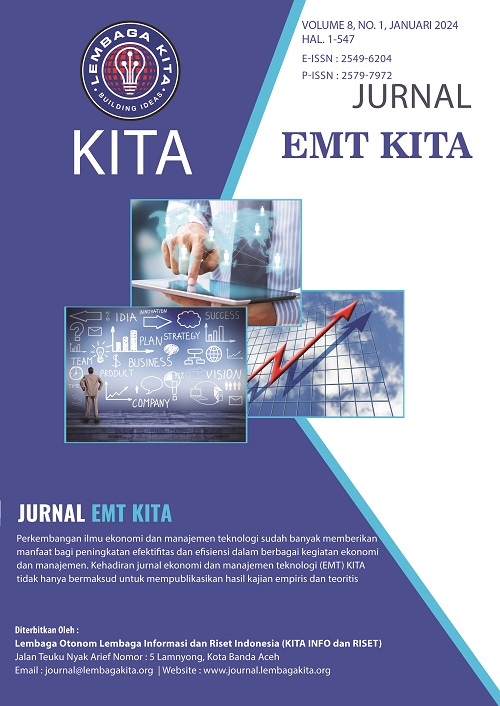
Pengaruh Komunikasi Pemasaran melalui Motivasi Konsumen pada Keputusan Pengguna Kartu Halo: Studi Kasus di Kota Padang, Sorong, dan Bandung
DOI:
https://doi.org/10.35870/emt.v8i1.2092Keywords:
Marketing Communications, Consumer Motivation, Consumer Decisions, Halo CardAbstract
The purpose of this study was to analyze the effect of Company Size, Profitability, and Public Accounting Firm Size on Audit Report Lag (Empirical Study of Food and Beverage Sub-Sector Manufacturing Companies Listed on Bei in 2020-2022). This type of research is quantitative. The data used in this study were obtained from the official website of the Indonesia Stock Exchange regarding the annual report of food and beverage sub-sector manufacturing companies in 2020-2022. The data in this study are secondary data. The data collection method is the documentation method, which is done by collecting audited annual financial reports listed on the Indonesia Stock Exchange for the 2020-2022 period and available on the official website www.idx.co.id. The literature study method is carried out by analyzing journals, books, and other sources. This study uses descriptive statistical analysis methods, classical assumption tests, multiple linear regression analysis, coefficient of determination, and hypothesis testing. Hypothesis testing includes classical assumption tests as a condition of multiple linear regression. Company size has no effect on audit report lag with a t value of 0.633 and a significance of 0.528> 0.05. Profitability has a negative and significant effect on audit report lag with a t value of -2.991 and a significance of 0.003 <0.05. KAP size has a negative and significant effect on audit report lag with a t value of -3.096 and a significance of 0.002 <0.05.
Downloads
References
Abedniya, A., & Mahmouei, S. S. (2010). The impact of social networking websites to facilitate the effectiveness of viral marketing. International Journal of Advanced Computer Science and Applications, 1(6).
Alavi, S. A., Rezaei, S., Valaei, N., & Wan Ismail, W. K. (2016). Examining shopping mall consumer decision-making styles, satisfaction and purchase intention. The International Review of Retail, Distribution and Consumer Research, 26(3), 272-303.
Alvarizi, R., & Purnamasari, D. (2023). Pengaruh Online Customer Review E-Wom Content Marketing pada Keputusan Pembelian UMKM Semarang melalui Tiktok. Jurnal JTIK (Jurnal Teknologi Informasi dan Komunikasi), 7(3), 430-436.
Ananta, D., & Hapsari, E. W. (2015). Motivasi Berprestasi pada Penderita Spondyloarthritides dengan Jenis Enteropathic Arthritis. EXPERIENTIA: Jurnal Psikologi Indonesia, 3(1), 121-132.
Aprilia, A., & Sekarwati, D. A. (2022). PERAN TRUST SEBAGAI MEDIASI ANTARA GAYA HIDUP DAN MOTIVASI KONSUMEN DALAM MENENTUKAN KEPUTUSAN PEMBELIAN ONLINE: Studi Kasus pada Platform Instagram. Sinergi: Jurnal Ekonomi, Bisnis dan Manajemen, 1(3), 62-72.
Benda-Prokeinová, R., Dobeš, K., Mura, L., & Buleca, J. (2017). Engel´ s approach as a tool for estimating consumer behaviour.
Binalay, A. G., Mandey, S. L., & Mintardjo, C. M. (2016). Pengaruh Sikap, Norma Subjektif Dan Motivasi Terhadap Minat Beli Secara Online Pada Mahasiswa Fakultas Ekonomi Dan Bisnis Di Manado. Jurnal EMBA: Jurnal Riset Ekonomi, Manajemen, Bisnis dan Akuntansi, 4(1).
Burhan, N. S., Noviani, L., & Sangka, K. B. (2023). Pengaruh Kemudahan Belanja Online dan Pengendalian Diri Terhadap Perilaku Konsumtif dengan Peminatan Ekonomi Sebagai Variabel Moderator. Journal on Education, 5(4), 15058-15068.
Camilleri, M. A., & Camilleri, M. A. (2018). Integrated marketing communications (pp. 85-103). Springer International Publishing.
Chitty, B., Chitty, W., Luck, E., Barker, N., Sassenberg, A. M., Shimp, T. A., & Andrews, J. C. (2017). Integrated Marketing Communications with Online Study Tools 12 Months. Cengage AU.
Dahlén, M., Lange, F., & Smith, T. (2009). Marketing communications: A brand narrative approach. John Wiley & Sons.
d'Alessandro, S., Winzar, H., Lowe, B., & Zikmund, W. (2020). Marketing Research. Cengage AU.
Eagle, L., Czarnecka, B., Dahl, S., & Lloyd, J. (2020). Marketing communications. Routledge.
Gamble, J., Gilmore, A., McCartan-Quinn, D., & Durkan, P. (2011). The Marketing concept in the 21st century: A review of how Marketing has been defined since the 1960s. The marketing review, 11(3), 227-248.
Handoko, L. T. (2005). Scientific and financial performance measure: A simultaneous model to evaluate scientific activities. arXiv preprint physics/0508052.
Häubl, G., & Trifts, V. (2000). Consumer decision making in online shopping environments: The effects of interactive decision aids. Marketing science, 19(1), 4-21.
Kaetza, R. V., & Purnamasari, D. (2023). Pengaruh Digital Marketing, Goldilock Effect, dan Loyalitas Pelanggan Terhadap Keputusan Pembelian Online Pengguna Aplikasi Matahari. Jurnal EMT KITA, 7(4), 839-848.
Kotler, P., & Keller, K. L. (2009). Menejemen Pemasaran. Penerbit: Erlanggga. Jakarta.
Kotler, P., Armstrong, G., Ang, S. H., Leong, S. M., Tan, C. T., & YAU, O. (2008). Principles of marketing: An global perspective.
Marta, K. (2016). Influence of the brand on purchase decision. Age, 15(24), 23.
Mital, A., Desai, A., Subramanian, A., & Mital, A. (2014). Product development: a structured approach to consumer product development, design, and manufacture. Elsevier.
Downloads
Published
Issue
Section
License
Copyright (c) 2024 Erizal Nazaruddin, Ferdinant Nuru, Dudi Yudhakusuma

This work is licensed under a Creative Commons Attribution-NonCommercial-NoDerivatives 4.0 International License.
Authors who publish with this journal agree to the following terms:
1. Copyright Retention and Open Access License
Authors retain copyright of their work and grant the journal non-exclusive right of first publication under the Creative Commons Attribution 4.0 International License (CC BY 4.0).
This license allows unrestricted use, distribution, and reproduction in any medium, provided the original work is properly cited.
2. Rights Granted Under CC BY 4.0
Under this license, readers are free to:
- Share — copy and redistribute the material in any medium or format
- Adapt — remix, transform, and build upon the material for any purpose, including commercial use
- No additional restrictions — the licensor cannot revoke these freedoms as long as license terms are followed
3. Attribution Requirements
All uses must include:
- Proper citation of the original work
- Link to the Creative Commons license
- Indication if changes were made to the original work
- No suggestion that the licensor endorses the user or their use
4. Additional Distribution Rights
Authors may:
- Deposit the published version in institutional repositories
- Share through academic social networks
- Include in books, monographs, or other publications
- Post on personal or institutional websites
Requirement: All additional distributions must maintain the CC BY 4.0 license and proper attribution.
5. Self-Archiving and Pre-Print Sharing
Authors are encouraged to:
- Share pre-prints and post-prints online
- Deposit in subject-specific repositories (e.g., arXiv, bioRxiv)
- Engage in scholarly communication throughout the publication process
6. Open Access Commitment
This journal provides immediate open access to all content, supporting the global exchange of knowledge without financial, legal, or technical barriers.