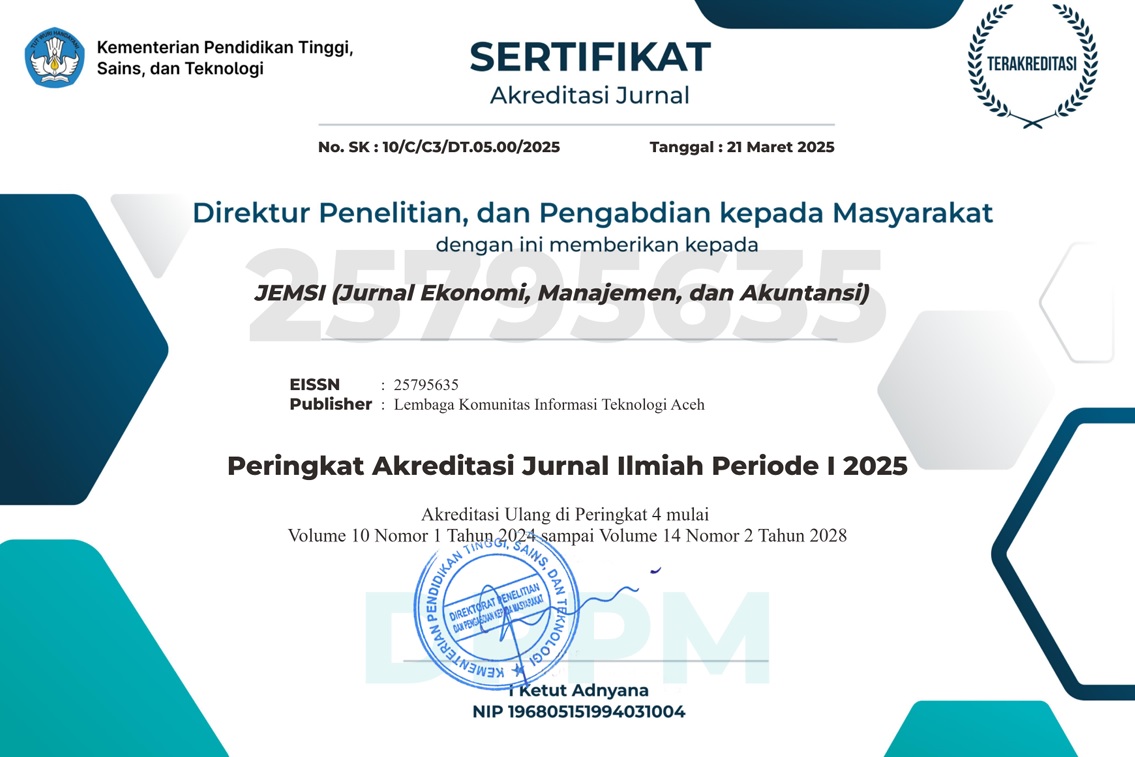
The Influence Of Leadership Style, Motivation, And Work Discipline On Employee Performance Pt. Putra Soegama Group
DOI:
https://doi.org/10.35870/jemsi.v9i2.1017Keywords:
eWOM, Information Quality, Customer, Instagram, Purchase IntentionAbstract
This research aims to analyze the potential influence of leadership style, motivation, and work discipline on employee performance. This research falls under the category of explanatory research, encompassing all employees in the research population. This research used non-probability sampling and judgmental sampling methods to select a sample of 100 workers. The researcher collected information through questionnaire distribution and analyzed the data using a quantitative descriptive approach. Research findings show that leadership style, motivation, and work discipline have a positive and significant impact on employee performance. Leadership style, with a regression coefficient of 0.371 and a t statistic of 4.450, confirms a significant positive influence on performance. Likewise with motivation, which has a regression coefficient of 0.176 and a t statistic of 2.025, and work discipline, which has a regression coefficient of 0.381 and a t statistic of 4.489, both of which also make a significant positive contribution to performance. Together or simultaneously, leadership style, motivation, and work discipline are able to explain as much as 70.7% of the variation in employee performance. Other variables or factors not included in this study account for the remaining 30.4%. These findings provide a comprehensive picture of the factors that influence employee performance, making a significant contribution to the understanding of the complex dynamics of the work environment.
Downloads
References
Azar, M., & Shafighi, A. A. (2013). The Effect of Work Motivation on Employees' Job Performance (Case Study: Employees of Isfahan Islamic Revolution Housing Foundation). International Journal of Academic Research in Business and Social Sciences, 3(9). https://doi.org/10.6007/IJARBSS/v3-i9/231
Farisi, S., Irnawati, J., & Fahmi, M. (2020). The Influence of Work Motivation and Discipline on Employee Performance. Jurnal Humaniora: Jurnal Ilmu Sosial, Ekonomi Dan Humaniora, 4(1), 15–33. https://doi.org/10.30601/humaniora.v4i1.420
Julfrizen. (2018). The Influence of Work Motivation in Moderating Compensation and Work Discipline on Employee Performance. Jurnal Prosiding The National Conference Management and Business, 1(1), 405–424.
M., Ardheta, P. A., & Paembolnan, Y. R. (2020). The Influence of Financial Distress and Audit Commitment on Profit Management in the Mining Sector. Jurnal STEI Ekonomi, 29(01), 71–78. https://doi.org/10.36406/jemi.v29i01.300
Pawirolsulmartol, S., Sarjana, P. K., & Mulchtar, M. (2017). Factors affecting employee performance. International Journal of Law and Management, 59(4), 602–614. https://doi.org/10.1108/IJLMA-03-2016-0031
Volon, M. L., Lo, M. C., Nguli, K. S., & Ayob, N. B. (2011). The influence of leadership styles on employee job satisfaction in public sector organizations Malaysia. International Journal of Business, Management and Social Sciences, 2(1), 24–32.
Wibowo. (2013). Behavior in Organizations. PT. Raja Grafindo Persada.
Downloads
Published
Issue
Section
License
Authors who publish with this journal agree to the following terms:
1. Copyright Retention and Open Access License
Authors retain copyright of their work and grant the journal non-exclusive right of first publication under the Creative Commons Attribution 4.0 International License (CC BY 4.0).
This license allows unrestricted use, distribution, and reproduction in any medium, provided the original work is properly cited.
2. Rights Granted Under CC BY 4.0
Under this license, readers are free to:
- Share — copy and redistribute the material in any medium or format
- Adapt — remix, transform, and build upon the material for any purpose, including commercial use
- No additional restrictions — the licensor cannot revoke these freedoms as long as license terms are followed
3. Attribution Requirements
All uses must include:
- Proper citation of the original work
- Link to the Creative Commons license
- Indication if changes were made to the original work
- No suggestion that the licensor endorses the user or their use
4. Additional Distribution Rights
Authors may:
- Deposit the published version in institutional repositories
- Share through academic social networks
- Include in books, monographs, or other publications
- Post on personal or institutional websites
Requirement: All additional distributions must maintain the CC BY 4.0 license and proper attribution.
5. Self-Archiving and Pre-Print Sharing
Authors are encouraged to:
- Share pre-prints and post-prints online
- Deposit in subject-specific repositories (e.g., arXiv, bioRxiv)
- Engage in scholarly communication throughout the publication process
6. Open Access Commitment
This journal provides immediate open access to all content, supporting the global exchange of knowledge without financial, legal, or technical barriers.