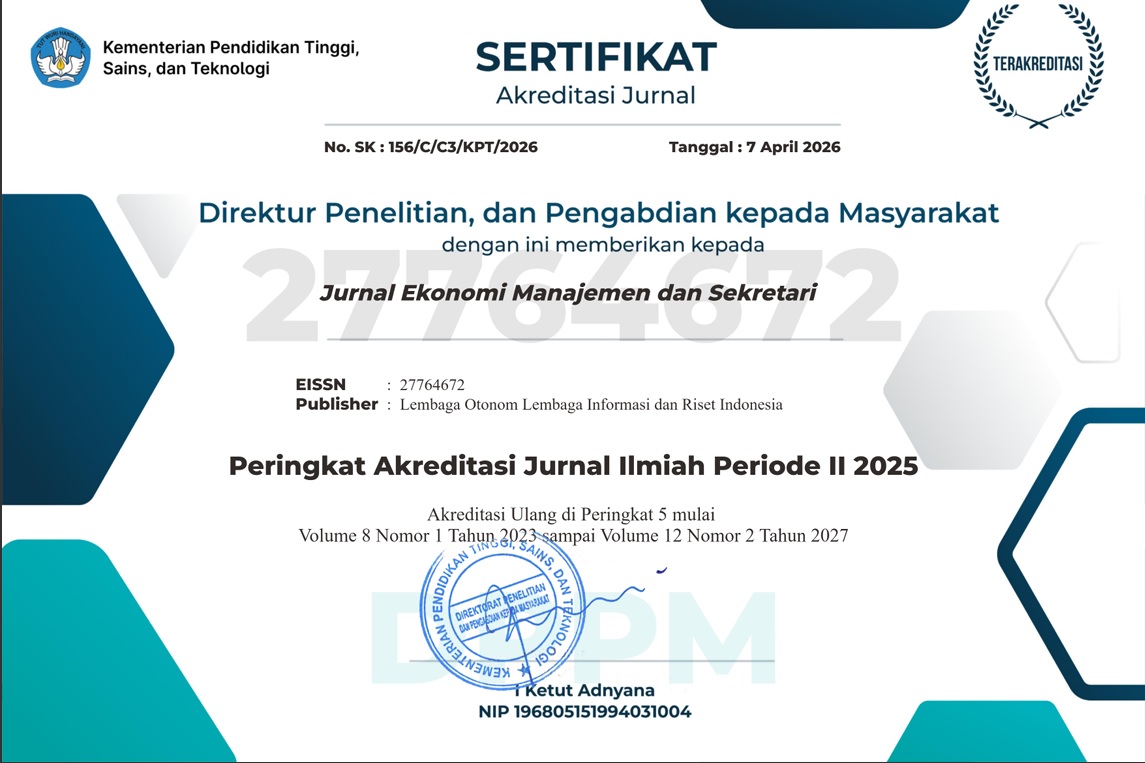
Pengaruh Pajak Daerah dan Belanja Pemerintah Terhadap Pertumbuhan Ekonomi di Provinsi Aceh Tahun 2008 - 2018
DOI:
https://doi.org/10.35870/jemensri.v8i3.3043Keywords:
Local tax, Government Expenditure, Economic GrowthAbstract
This research was conducted in Aceh province for the 2008-2018 period. The aim of this research is to determine the influence of regional taxes and government spending on economic growth in Aceh province in 2008-2018. This research uses secondary data for the 2008-2018 period sourced from the Central Statistics Agency and the Aceh Financial Management Agency. In this study, time series linear regression analysis was used using the eviews 9 analysis tool. The data used was 11 year time series data. Based on the results of tests carried out with probability on variables, it can be concluded that regional taxes and government spending have a positive and significant influence on economic growth in the narrow sense in Indonesia. From the results of the data regression carried out, the R2 (Coefficient of Determination) value is 0.689762, this means that 68.97% of GRDP at constant prices in Aceh province can be explained by regional tax and government spending variables, while the remainder is 31.03% influenced by other variables.
Downloads
References
of Policy and Development studies, 289(1849), 1-13.
Abdieva, R., Baigonushova, D., & Ganiev, J. (2017). Relationship between government expenditure and economic growth in transition Countries: Case of Kyrgyzstan and Tajikistan. Bilig, (83), 241-258.
Abdullah, M. A., & Rusdarti, R. (2017). The Impact of Government Expenditure on Economic Growth in Indonesia, Malaysia and Singapore. Journal of Economic Education, 6(1), 11-18.
Akhor, S. O., & Ekundayo, O. U. (2016). The impact of indirect tax revenue on economic growth: The Nigeria experience. Igbinedion University Journal of Accounting, 2(08), 62-87.
Amri, K., Masbar, R., & Aimon, H. (2019). Is there a causality relationship between local tax revenue and regional economic growth? A panel data evidence from indonesia. Regional Science Inquiry, 11(1), 73-84.
Babatunde, S. A. (2018). Government spending on infrastructure and economic growth in Nigeria. Economic research-Ekonomska istraživanja, 31(1), 997-1014.
Çakerri, L., Petanaj, M., & Muharremi, O. (2014). The effect of government expenditures on economic growth. The case of Albania. European Journal of Social Sciences Education and Research, 1(2), 242-254.
Chude, N. P., & Chude, D. I. (2013). Impact of government expenditure on economic growth in Nigeria. International journal of business and management review, 1(4), 64-71.
Dandan, M. M. (2011, February). Government expenditures and economic growth in Jordan. In International Conference on Economics and Finance Research, Singapore (Vol. 4, pp. 467-471).
Dewi, J. K., & Budhi, M. K. S. (2018). Analisis pengaruh pajak daerah, retribusi daerah terhadap tenaga kerja dan pertumbuhan ekonomi di Kota Palangka Raya Provinsi Kalimantan Tengah. E-Jurnal Ekonomi Dan Bisnis Universitas Udayana, 7(6), 1695-1722.
Dolenc, P., & Laporšek, S. (2012). Labour taxation and its impact on employment growth. Managing Global Transitions, 10(3), 301-318.
Ebong, F., Ogwumike, F., Udongwo, U., & Ayodele, O. (2016). Impact of government expenditure on economic growth in Nigeria: A disaggregated analysis. Asian journal of economics and empirical research, 3(1), 113-121.
Egbunike, F. C., Emudainohwo, O. B., & Gunardi, A. (2018). Tax revenue and economic growth: A study of Nigeria and Ghana. Signifikan: Jurnal Ilmu Ekonomi, 7(2), 213-220.
Fasoranti, M. M. (2012). The effect of government expenditure on infrastructure on the growth of the Nigerian economy, 1977-2009. International Journal of Economics and Financial Issues, 2(4), 513-518.
Gangal, V. L., & Gupta, H. (2013). Public expenditure and economic growth: A case study of India. Global Journal of Management and Business Studies, 3(2), 191-196.
Jelilov, G., & Musa, M. (2016). The impact of government expenditure on economic growth in Nigeria. Sacha Journal of Policy and Strategic Studies, 5(1), 15-23.
Ladan, H. (2017). Public expenditure and economic growth in nigeria: an application of co-integration and error correction modeling. Journal of Economics and Business Research, 23(1), 185-208.
Lahirushan, K. P. K. S., & Gunasekara, W. G. V. (2015). The impact of government expenditure on economic growth: A study of Asian countries. International Journal of Humanities and Social Sciences, 9(9), 3152-3160.
Leasiwal, T. C. (2016). Pengaruh Investasi Pemerintah, Konsumsi Pemerintah, Pajak dan Retribusi Terhadap Pertumbuhan Ekonomi di Provinsi Maluku. Jurnal Ekonomi, X (1), 69-81.
Loizides, J., & Vamvoukas, G. (2005). Government expenditure and economic growth: Evidence from trivariate causality testing. Journal of Applied Economics, 8(1), 125-152. DOI: https://doi.org/10.1080/15140326.2005.12040621.
Macek, R. (2014). The impact of taxation on economic growth: Case study of OECD countries. Review of economic perspectives, 14(4), 309-328.
Maingi, J. N. (2017). The impact of government expenditure on economic growth in Kenya: 1963-2008. Advances in Economics and Business, 5(12), 635-662.
Muhammad, F., Xu, T., & Karim, R. (2015). Impact of expenditure on economic growth in Pakistan. International Journal of Academic Research in Business and Social Sciences, 5(2), 231-236.
Myles, G. D. (2000). Taxation and economic growth. Fiscal studies, 21(1), 141-168. DOI: https://doi.org/10.1111/j.1475-5890.2000.tb00583.x.
Nworji, I. D., Okwu, A. T., Obiwuru, T. C., & Nworji, L. O. (2012). Effects of public expenditure on economic growth in Nigeria: A disaggregated time series analysis. International journal of management sciences and business research, 1(7), 1-15.
Onakoya, A. B., & Afintinni, O. I. (2016). Taxation and economic growth in Nigeria. Asian Journal of Economic Modelling, 4(4), 199-210.
Poulson, B. W., & Kaplan, J. G. (2008). State income taxes and economic growth. Cato J., 28, 53.
Stoilova, D., & Patonov, N. (2013). An empirical evidence for the impact of taxation on economy growth in the European Union. Tourism & Management Studies, (3), 1031-1039.
Sukirno, S. (2004). Makroekonomi teori pengantar.
Veronika, B., & Lenka, J. (2012). Taxation of corporations and their impact on economic growth: The case of EU countries. Journal of competitiveness, 4(4), 96-108.
Yi, F., & Suyono, E. (2014). The relationship between tax revenue and economic growth of Hebei province based on the tax multiplier effect. Global Economy and Finance Journal, 7(2), 1-18.
Downloads
Published
Issue
Section
License
Authors who publish with this journal agree to the following terms:
1. Copyright Retention and Open Access License
Authors retain copyright of their work and grant the journal non-exclusive right of first publication under the Creative Commons Attribution 4.0 International License (CC BY 4.0).
This license allows unrestricted use, distribution, and reproduction in any medium, provided the original work is properly cited.
2. Rights Granted Under CC BY 4.0
Under this license, readers are free to:
- Share — copy and redistribute the material in any medium or format
- Adapt — remix, transform, and build upon the material for any purpose, including commercial use
- No additional restrictions — the licensor cannot revoke these freedoms as long as license terms are followed
3. Attribution Requirements
All uses must include:
- Proper citation of the original work
- Link to the Creative Commons license
- Indication if changes were made to the original work
- No suggestion that the licensor endorses the user or their use
4. Additional Distribution Rights
Authors may:
- Deposit the published version in institutional repositories
- Share through academic social networks
- Include in books, monographs, or other publications
- Post on personal or institutional websites
Requirement: All additional distributions must maintain the CC BY 4.0 license and proper attribution.
5. Self-Archiving and Pre-Print Sharing
Authors are encouraged to:
- Share pre-prints and post-prints online
- Deposit in subject-specific repositories (e.g., arXiv, bioRxiv)
- Engage in scholarly communication throughout the publication process
6. Open Access Commitment
This journal provides immediate open access to all content, supporting the global exchange of knowledge without financial, legal, or technical barriers.